
PLANTSONICS · PLANT PULSE · SCIENCE & NEWS
Your Plant Called for Backup. The Wasp Showed Up.
When a caterpillar starts eating a leaf, the plant doesn’t just endure it. It releases a chemical signal — and the specific wasp that kills that specific caterpillar flies in to answer the call.
A caterpillar lands on a leaf and starts chewing.
To the human eye, nothing happens. The plant sits there. The caterpillar eats. Within a few hours, the leaf will have holes. Within a few days, it might be gone.
But inside the plant, something completely different is unfolding. The moment the caterpillar’s jaw closes on plant tissue; a chemical alarm system fires. The plant begins producing and releasing specific volatile compounds into the air — compounds so precisely tuned that they don’t just say ‘I am being eaten.’ They say which caterpillar is doing the eating.
And somewhere within flying distance, a very particular kind of wasp catches that scent and changes course.
The plant isn’t sending a generic distress signal. It’s placing a targeted order — and the right predator is on the way.
The Discovery
The story starts in the early 1990s with research led by Ted Turlings, then at the USDA Insect Attractants Laboratory in Gainesville, Florida. Turlings and his colleagues were studying corn plants under attack by caterpillars. They noticed something striking: the wounded plants were releasing a distinct chemical cocktail into the air — and those compounds appeared to be attracting parasitic wasps to the scene.
In a landmark 1995 paper published in the Proceedings of the National Academy of Sciences, Turlings and his team demonstrated the mechanism clearly. Plants being fed on by caterpillars released herbivore-induced plant volatiles — a family of airborne compounds, now known in the scientific literature as HIPVs. These volatiles travel on the breeze, and specific wasp species use them as foraging cues to locate their prey.
Three years later, a follow-up study published in Nature by Consuelo De Moraes and her colleagues pushed the finding further. The chemical signal wasn’t generic. Plants attacked by one species of caterpillar released a different volatile blend than the same species of plant attacked by a different caterpillar. The wasps — specialists, each one evolved to parasitize a particular caterpillar species — could tell the difference.
The Villain and the Assassin
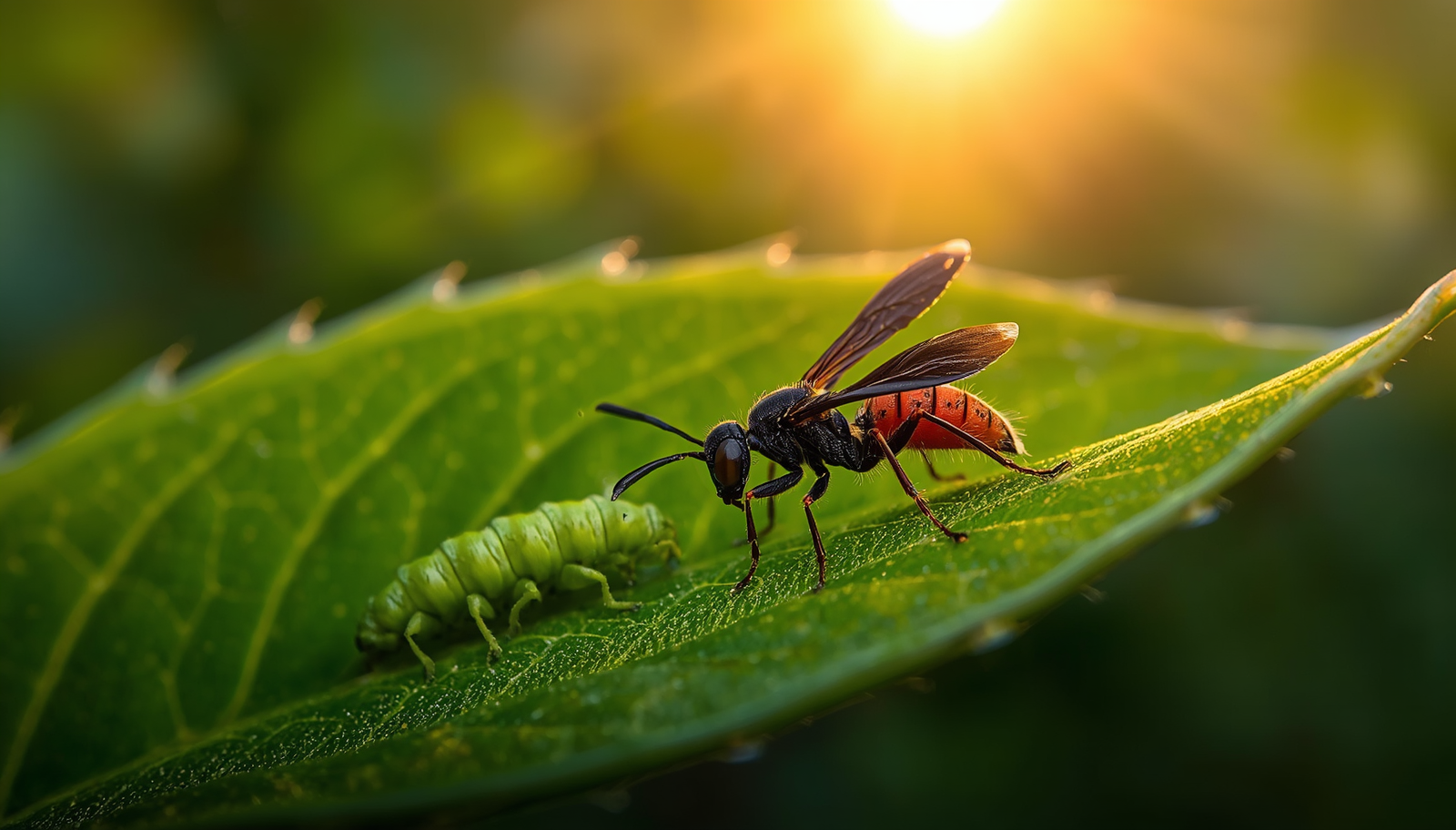
One of the best-documented examples involves tobacco plants, tobacco budworm caterpillars (Heliothis virescens), and a parasitic wasp called Cardiochiles nigriceps. The budworm is a serious agricultural pest that feeds on tobacco, cotton, and a range of row crops. The wasp is about a quarter of an inch long, with black wings and a distinctive reddish-brown abdomen — which is why it’s sometimes called the red-tailed wasp.
When the budworm begins feeding, the tobacco plant releases its species-specific volatile signature. The wasp, following the scent, locates the caterpillar on the leaf. It lands, extends its ovipositor, and inserts a single egg into the caterpillar’s body.
Then it flies away.
The caterpillar continues eating — for a while. Inside its body, the wasp egg hatches. The wasp larva begins consuming the caterpillar from the inside out, carefully avoiding vital organs at first so the host stays alive and keeps feeding the parasite. By the time the caterpillar dies, the wasp larva has grown large enough to pupate. A new generation of wasps emerges, ready to find their own caterpillars.
A note on scale: A 1998 USDA field study found that in plots where this signaling system was active, 32 of 48 caterpillars were successfully parasitized — a rate that substantially reduced crop damage compared to untreated plots. This is not a rare curiosity. It is one of the core mechanisms by which plants survive in a world full of things that want to eat them.
What Does a Plant ‘Know’?
The instinct when you first hear this is to reach for human language. The plant is ‘calling’ for help. It ‘recognizes’ its attacker. It ‘chooses’ its ally. None of those words are quite right — and the scientists who study this work are careful about them.
What we can say is this: the plant is running a sophisticated, targeted, chemical response system that distinguishes between different threats and produces different outputs based on what’s attacking it. Whether that constitutes ‘intelligence’ depends on how you define the word. There is no brain doing this. There are no nerves, no central processor, no consciousness in any sense humans have ever been able to measure.
What there is — distributed across millions of cells, encoded in the plant’s chemistry — is a response system that looks, functionally, an awful lot like decision-making.
The plant has no brain. It has something else — a way of processing information that evolved on a completely different architecture than ours.
The caterpillar-wasp signaling system is one of dozens of examples researchers have now documented. Plants warn neighboring plants of insect attacks through airborne chemicals. They adjust their defenses based on the specific pest attacking them. They recognize close relatives growing nearby and share resources underground through fungal networks. They remember. They respond. They adapt.
They do all of this silently, without moving, and almost entirely out of sight.
The Quiet Intelligence in the Room
The houseplant on your desk right now — the pothos, the monstera, the succulent you keep forgetting to water — is running systems this sophisticated all the time. It is sensing light, temperature, humidity, touch, and the presence of pests. It is producing chemical responses to each. Most of what it does, you will never see or hear.
Researchers are still uncovering new layers of the story. In the three decades since Turlings’s original paper, scientists have documented hundreds of plant species using volatile chemical signaling to summon predators, warn neighboring plants of attack, and prepare their own tissues for defense. The tritrophic system — plant, herbivore, predator — is now understood to be one of the foundational architectures of terrestrial ecosystems.
The next time you walk past a plant, remember it is already communicating. It has been the whole time. We are simply, slowly, learning how to listen.
SOURCES & FURTHER READING
Turlings, T.C.J., Loughrin, J.H., McCall, P.J., Röse, U.S.R., Lewis, W.J., & Tumlinson, J.H. (1995). How caterpillar-damaged plants protect themselves by attracting parasitic wasps. Proceedings of the National Academy of Sciences, 92(10), 4169–4174. Free full text: https://pmc.ncbi.nlm.nih.gov/articles/PMC41905/
De Moraes, C.M., Lewis, W.J., Paré, P.W., Alborn, H.T., & Tumlinson, J.H. (1998). Herbivore-infested plants selectively attract parasitoids. Nature, 393, 570–573. DOI: https://doi.org/10.1038/31219
Kessler, A., & Baldwin, I.T. (2001). Defensive function of herbivore-induced plant volatile emissions in nature. Science, 291(5511), 2141–2144. DOI: https://doi.org/10.1126/science.291.5511.2141
Turlings, T.C.J., Tumlinson, J.H., & Lewis, W.J. (1990). Exploitation of herbivore-induced plant odors by host-seeking parasitic wasps. Science, 250(4985), 1251–1253. DOI: https://doi.org/10.1126/science.250.4985.1251
USDA Agricultural Research Service. (1998). Plants Send SOS When Caterpillars Bite. Agricultural Research Magazine, October 1998. Archive: https://agresearchmag.ars.usda.gov/
For a general-audience introduction to this research field:
Schlanger, Z. (2024). The Light Eaters: How the Unseen World of Plant Intelligence Offers a New Understanding of Life on Earth.Harper. (New York Times bestseller, TIME Top 10 Nonfiction 2024.)